

A Small Business Guide to AI Search Visibility
The Weekend Entity Audit: The New Search Reality: From Blue Links to Synthesized Answers

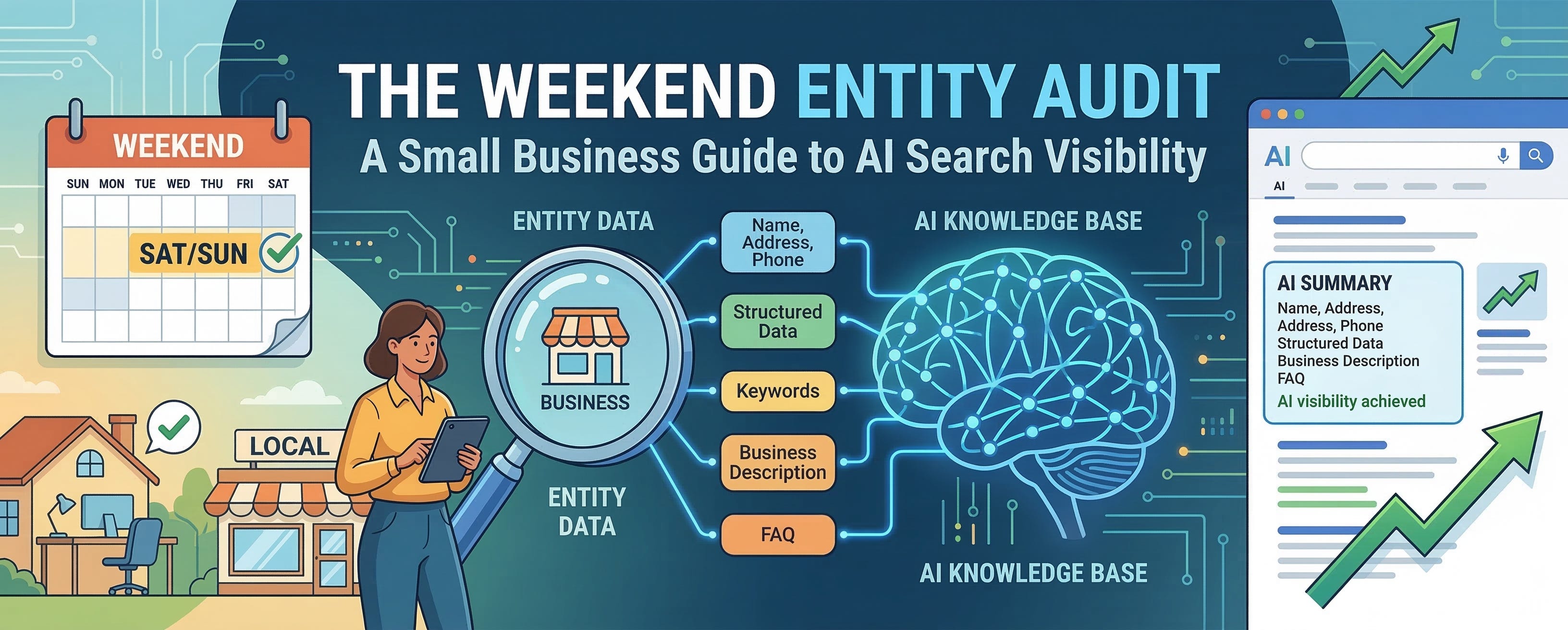
The search landscape has shifted from a library of links to an engine of answers. We have entered the “Zero-Click” reality of 2026, where Large Language Models (LLMs) like ChatGPT, Perplexity, and Gemini synthesize brand data into conversational responses. While traditional organic traffic is projected to decline significantly through 2027, the opportunity for small businesses has never been higher: AI search visitors convert 4.4x better than traditional organic visitors. Because these users are already “pre-sold” by the AI’s synthesis, a brand mention is now as valuable as a website click.
The 2026 Search Shift
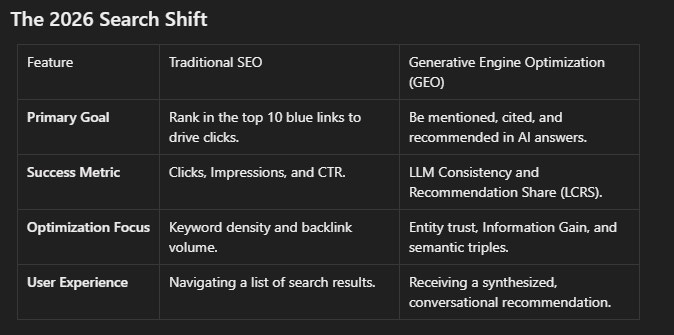
To win this weekend, we are targeting the three levels of LLM visibility:
Indexed: Your data is known to the model’s training set or real-time crawler.
Cited: Your content is used as a specific supporting reference (with a link).
Recommended: The AI actively surfaces your brand as the “best” or “preferred” solution.
Success at all three levels requires a Foundation of Trust. AI models act as “stricter versions of search”—they cross-check your data against the entire web before they dare to recommend you to a user.
Friday Evening | Phase 1: The Identity Audit (Building Entity Trust)
Tonight, we ensure the AI knows exactly who you are. AI models perform a digital background check on your brand. If they find contradictions in your Business Name, Address, or Phone Number (NAP), they view you as a high-risk recommendation. We are building your brand’s “Identity Card.”
The Information Gain Mandate Before you audit your content, understand that AI rewards Information Gain. Research shows that content providing unique value—original quotes, proprietary data, or unique case studies—is mentioned 30–40% more often than regurgitated “SEO fluff.”
Foundational Trust Checklist
Consistent Branding: Is your Business Name identical across your website, social profiles, and local directories?
Core Service Language: Do you use the same 3–5 phrases to describe your primary services everywhere?
Crawlable Contact Info: Is your phone number and address in plain HTML text (not an image or JavaScript)?
Website “About” Page: Does it clearly identify the “Who” behind the business to satisfy E-E-A-T (Experience, Expertise, Authoritativeness, Trustworthiness)?
Service Area Definitions: Are your service locations defined using the same terminology on your site and your Google Business Profile?
Website Context Audit
Review your “About” and “Service” pages. Remove marketing fluff. Replace it with direct, factual statements. AI prefers “We provide [Service] to [Audience] in [Location]” over “We are a world-class leader in innovative solutions.”
Saturday Morning | Phase 2: The Presence Audit (Mapping the Information Layer)
AI answers are built on the “Information Layer”—a map of third-party citations and local data. To overcome the “Big Brand Bias” inherent in LLMs, small businesses must dominate Earned Media. AI often trusts what a local news site says about you more than what you say about yourself.
High-Priority Platforms
AI tools check these authoritative sources most frequently to validate your entity:
Search/Maps: Google Business Profile, Bing Places, Apple Business Connect.
Aggregators: Yelp, TripAdvisor, and industry-specific directories (e.g., Houzz for contractors).
Professional: LinkedIn and Crunchbase (crucial for “Organization” entity status).
Earned Visibility Checklist
Local News/Blogs: Do you have at least one mention in a city-specific publication or neighborhood blog?
“Best Of” Listicles: Are you featured in local roundups? (e.g., “Top 5 HVACs in [City]”).
Expert Quotes: Is your name or brand cited as an expert source in an industry article?
Branded Search Volume: Are people searching for your brand by name? (LLMs track this as a signal of authority).
A consistent story across these platforms creates a “semantic footprint.” When the AI sees the same facts on your site, Apple Maps, and a local news site, its confidence in recommending you skyrockets.
Saturday Afternoon | Phase 4: Technical Health & Machine Scannability
AI visibility often fails because of technical friction. If an AI crawler can’t “chunk” your data, it won’t cite you.
Semantic Triples: The Language of AI
To help AI parse your data, structure your key sentences as Semantic Triples: Subject → Predicate → Object.
Bad: “Innovation is what we do when we help homeowners with plumbing.”
Good (Triple): “[Brand Name] provides [Plumbing Repair] in [City Name].”
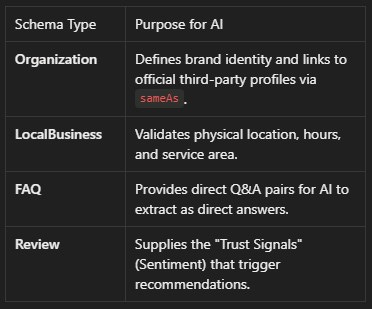
Essential Schema for AI Comprehension
Schema is a “language layer” that translates your site for AI. Ensure your Organization Schema uses the sameAs property to link your website to your social profiles and Wikipedia/Crunchbase pages—this is the “expert” way to connect the dots for the AI.
Technical Scannability Checklist
No JS Dependency: Is your critical brand info visible even if JavaScript is disabled?
Server-Side Rendering: Ensure your text content loads server-side for easier crawling.
Robots.txt: Verify you aren’t accidentally blocking AI crawlers (like GPTBot).
Answer-First Formatting: Do you lead with a clear 1-2 sentence answer before expanding into detail?
Sunday | Phase 3: The AI “Mirror” Test (Probing the Answer Engines)
Today we measure your LCRS (LLM Consistency and Recommendation Share). Because AI models are probabilistic (meaning they don’t give the same answer every time), you must run these prompts multiple times over 2–3 days to account for “temporal variability.”
High-Value Prompt Patterns
Run these across ChatGPT, Gemini, and Perplexity:
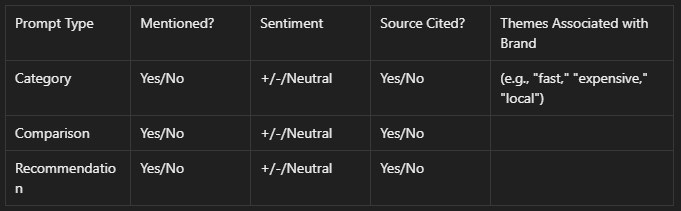
Category: “Who are the best [Service] providers in [City]?”
Comparison: “[Your Brand] vs [Top Competitor]—which is better for [Specific Use Case]?”
Recommendation: “I need a [Service] that handles [Specific Need]. What do you recommend?”
The AI Audit Scorecard
The 2026 Action Plan (The Monthly Execution Loop)
AI SEO is a compounding process. You won’t win overnight, but by building a “verifiable” footprint, you become the safest answer for the AI to provide.
Monthly AI SEO Checklist
Monitor AI Referrals: In GA4, filter traffic using a regex match for “ChatGPT|OpenAI|Perplexity|Gemini” to see which pages are winning citations.
Information Gain Refresh: Update one core service page with new original data, a fresh quote, or a 2026-specific statistic.
Earn One Mention: Secure one third-party mention (local blog, podcast, or directory) to expand your semantic footprint.
Re-Test LCRS: Run your Mirror Test prompts again. If your “Recommendation Share” is low, identify which competitor is being cited and audit their earned media sources.
The Fluff Lead: Starting pages with “In today’s fast-paced world...” (AI skips this; use Answer-First instead).
Identity Fragmentation: Using “ABC Plumbing” on your site but “ABC Plumbing & Drain” on Google Maps.
Regurgitation: Publishing content that can be found on ten other sites. If there is no Information Gain, there is no citation.
Final Thought: AI systems reward clarity and punish confusion. Win the sources that feed the answers, and you will show up even as the platforms change.