


The Strategic Architecture: Prioritization via the Eisenhower Matrix
In the modern digital landscape, brand authority is not a static asset but a dynamic state maintained through a disciplined administrative rhythm. As a Chief Operating Officer, one must view off-page Public Relations (PR) as the primary engine of E-E-A-T (Experience, Expertise, Authoritativeness, and Trustworthiness). Without a structured operational cadence, a small enterprise risks falling into a reactive posture—addressing crises rather than engineering growth—which leads to operational burnout and “authority decay.” A proactive schedule ensures consistent trust signals are transmitted to both human audiences and AI “answer engine” crawlers.
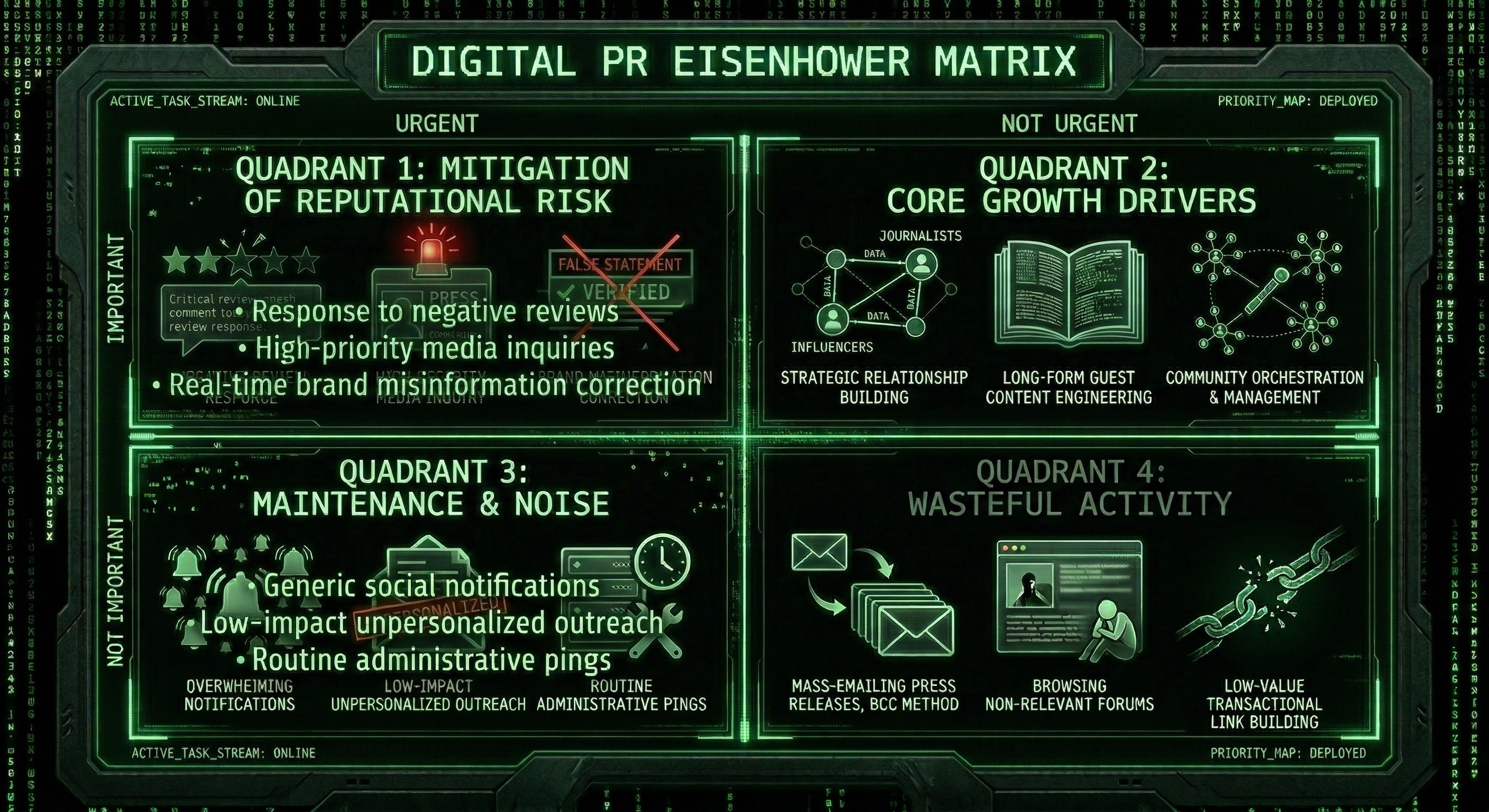
The following Eisenhower Matrix defines the prioritization framework for all off-page activities:
The Quadrant 2 Mandate
Long-term brand equity is forged almost exclusively in Quadrant 2. Activities such as cultivating journalist relationships and engineering 1,200-word industry reports are rarely urgent, leading many organizations to neglect them in favor of the Quadrant 3 “noise.” However, consistent neglect of these drivers results in a stale digital footprint. Mastery of this rhythm requires a deliberate, top-down mandate to shift resources toward these core growth drivers.
Strategic Transition: These priorities are operationalized through the Daily Cadence, where high-level goals are translated into rapid-response micro-interactions that signal brand vitality.
Daily Cadence: The Pulse of Community Orchestration
The “Daily Hour” is the fundamental unit of off-page health. Rapid response times and consistent engagement signal brand reliability to both human consumers and algorithmic crawlers. This daily pulse transforms the enterprise from an inanimate corporate entity into a trusted “human participant” in the digital town square.
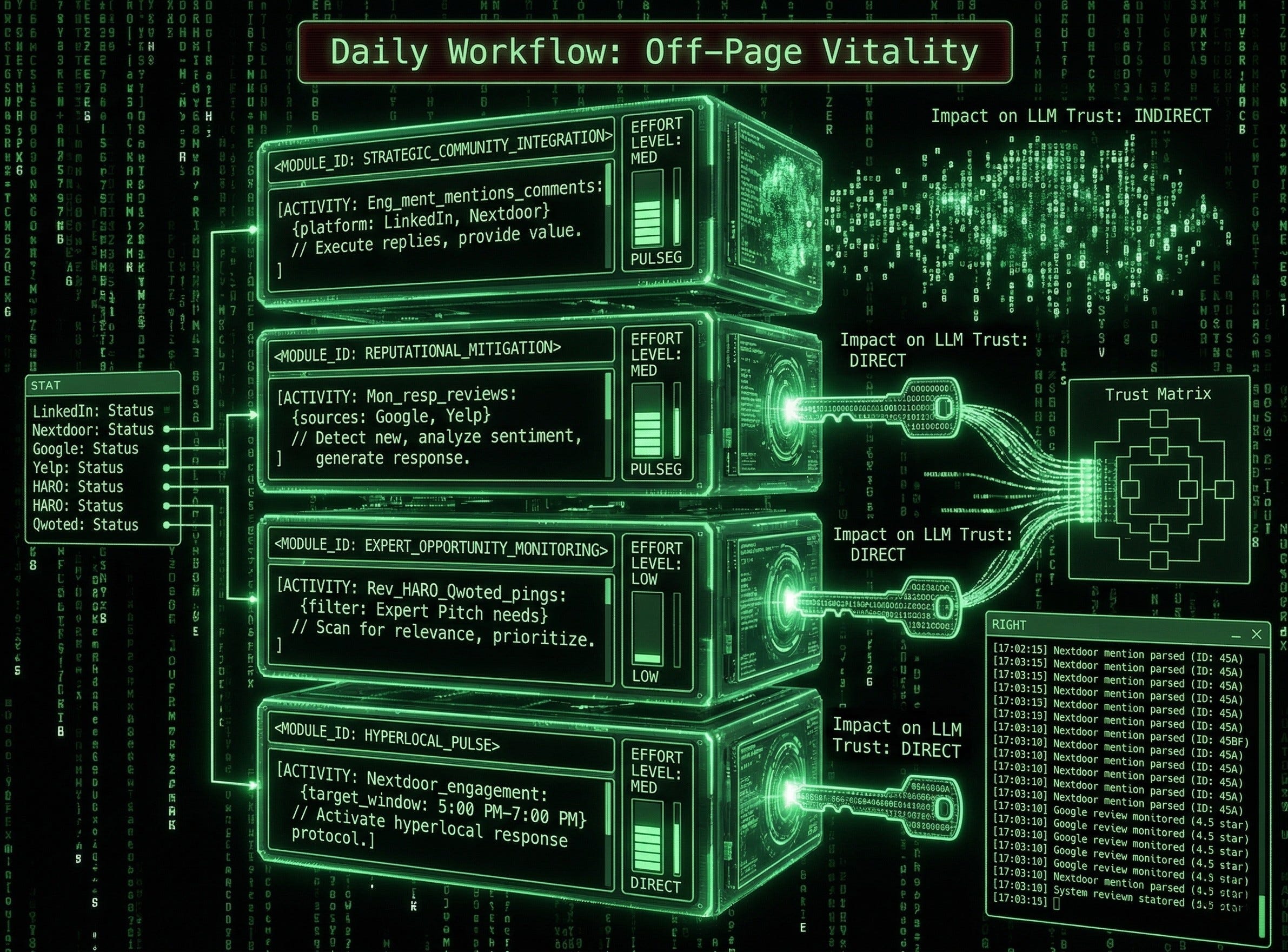
Note: Effort for Expert Monitoring is categorized as “Low” because it focuses on triaging pre-filtered inquiries, whereas community engagement requires “Medium” effort due to the necessity of nuanced, human-centric responses.
Review Etiquette and Compliance Mandate
All responses must adopt a warm, human tone. However, strict adherence to legal frameworks is non-negotiable:
CRFA Compliance: Per the Consumer Review Fairness Act, the enterprise is forbidden from prohibiting or penalizing honest negative feedback.
HIPAA & Privacy Protocols: For any health-related or sensitive service, staff are strictly forbidden from confirming patient identities or discussing specific treatments. Responses must remain generalized and direct the reviewer to a private channel for resolution.
Nextdoor Optimization: Maximize the “Neighborly Trust” signal. Statistics indicate that maintaining at least five recommendations correlates with a 30% increase in engagement. Posts should be scheduled for the high-activity window of 5:00 PM–7:00 PM on Thursdays and Fridays.
Strategic Transition: The data gathered during the “Daily Hour”—specifically frequently asked questions and high-sentiment social themes—serves as the intelligence required to engineer Tuesday’s long-form content.
Weekly Cadence: Content Engineering and Media Liaison
Effective off-page authority requires “Content CEO Time”—a dedicated 3–5 hour weekly window for batching high-value production. Batching prevents the fragmentation of focus and ensures that all assets meet the rigorous standards of top-tier industry outlets.
Weekly Operational Sequence
Monday: Marketing & Planning – Execute goal setting and asset outlining.
Tuesday: Content Engineering – Produce 800–1,200 word guest posts or industry reports. Requirement: Integrate visual-rich content (infographics/custom photography). Source data indicates visual-rich articles receive nearly double the views of text-only content.
Wednesday: Distribution Strategy – Schedule social updates and update the Google Business Profile (GBP) with weekly offers or news.
Thursday: Outreach & PR Orchestration – Execute personalized pitches to five targeted journalists or influencers.
Friday: Metric Review – Evaluate weekly performance and refine strategies for the following week.
The Art of the Pitch: Protocol & Etiquette
To maintain media relationships and avoid spam filters, staff must follow these rigid protocols:
Brevity: Pitches must be restricted to 150–200 words.
The Hook: Lead with a “Why Now” (e.g., a seasonal tie-in or timely data point).
Personalization: Mass-emailing (BCC-ing) is strictly forbidden. Every pitch must reference the recipient’s recent “beat.”
The Single Follow-Up Rule: If no response is received, a single polite follow-up is permitted after 3–5 days. If ignored thereafter, cease contact to preserve brand reputation.
Friction Reduction: Always include a link to a cloud-based media kit (bios, headshots, and brand facts).
Strategic Transition: Weekly media successes and content placements must be audited monthly to ensure they are contributing to the brand’s structural integrity.
Monthly Cadence: Ecosystem Audits and Deep Relationship Building
The monthly cadence is the “Structural Health Check” of the digital footprint. These high-level tasks prevent “Technical Debt”—the accumulation of inconsistent data that confuses search algorithms and erodes trust.
Monthly Administrative Checklist
Comprehensive NAP Audit: Verify Name, Address, and Phone number consistency across all structured citations (Yelp/GBP) and unstructured mentions (local news/blogs).
Analytics Deep-Dive: Evaluate Referral Traffic, Sentiment Analysis, and Membership Growth Rates.
Reputation Refresh: Proactively solicit reviews from the previous month’s clientele via neutral, direct links.
Web of Trust Networking: Connect with new industry vendors or local business partners for collaborative link exchanges or sponsorship opportunities.
The Analytical Mandate: The “So What?” of NAP
Search engines interpret inconsistent NAP data as a signal of unreliability. If geographic data varies across platforms, the brand’s local search rankings and “Map Pack” visibility will degrade, as algorithms will not confidently categorize the business’s physical relevance to the user.
Strategic Transition: Structural health sets the foundation for measuring high-level success through performance engineering.
Performance Engineering: Data Analytics and Brand Monitoring
The goal of this operational manual is to utilize Key Performance Indicators (KPIs) to “trim the fat” from the workflow, doubling down on high-ROI channels.
The KPI Framework
Reach & Engagement:
Potential Reach: Total viewers across all external placements.
Engagement Rate: Reactions + Comments + Shares / Total Impressions.
Community Health Formulas: \text{Membership Growth Rate} = \frac{(\text{Current Members} - \text{Starting Members})}{\text{Starting Members}} \times 100 \text{Churn Rate} = \frac{\text{Lost Members}}{\text{Total Members at Start}} \times 100
Conversion Engineering: Track Referral Traffic and event-based conversions (calls, direction requests) via GA4.
Advanced Brand Monitoring: The AI Answer Engine
In the age of Generative AI, traditional SEO is insufficient. The administrative team must utilize tools like LLMrefs to monitor brand visibility in AI “answer engines” (ChatGPT, Perplexity). Tracking brand citations in Reddit threads and authoritative blog comments is now a core requirement, as these sources are primary training data for the AI models that recommend brands to consumers.
Conclusion
Adherence to this operational rhythm ensures that a small enterprise moves beyond a static corporate presence to become an authoritative, human participant. This consistent cadence builds the E-E-A-T necessary to outcompete larger organizations, ensuring the brand is not merely visible, but cited as the primary authority in its field.