

The Great SEO Gaslight: Why "Writing for Humans" is a Trap in the AI Era
The Bouncer is a Robot (and He Doesn’t Care About Your Soul)


For the better part of two decades, the gospel of Google and the high priests of Search Engine Optimization have preached a singular, seemingly benevolent commandment: “Write for humans, not for search engines.” It’s a beautiful sentiment, isn’t it? It conjures up a utopian vision of the internet as a cozy, dimly lit coffee shop where artisan creators lovingly handcraft bespoke paragraphs for eager, organic readers. Google’s Webmaster guidelines, their “Helpful Content” updates, and thousands of LinkedIn SEO gurus have hammered this into our collective skulls. Be authentic. Be natural. Create for people.
It is also, unequivocally, the biggest lie on the internet.
And until we build entirely new, fundamentally AI-free platforms, following this advice is akin to committing digital suicide.
The Bouncer is a Robot (and He Doesn’t Care About Your Soul)
The fundamental hypocrisy of the “write for humans” doctrine lies in the architecture of distribution. Yes, a human might ultimately be the one to buy your product, subscribe to your newsletter, or validate your existence. But humans are not the gatekeepers.
Imagine writing a deeply moving, beautifully nuanced love letter to your partner, but before they are allowed to read it, you have to hand it to a literal cyborg bouncer standing outside their door. This cyborg doesn’t understand love, poetry, or nuance. It only understands structured data schemas, latent semantic indexing, and exact-match keyword proximity. If you don’t format your romantic confession with H2 tags and bulleted lists answering “People Also Ask” questions, the cyborg throws your letter in the incinerator.
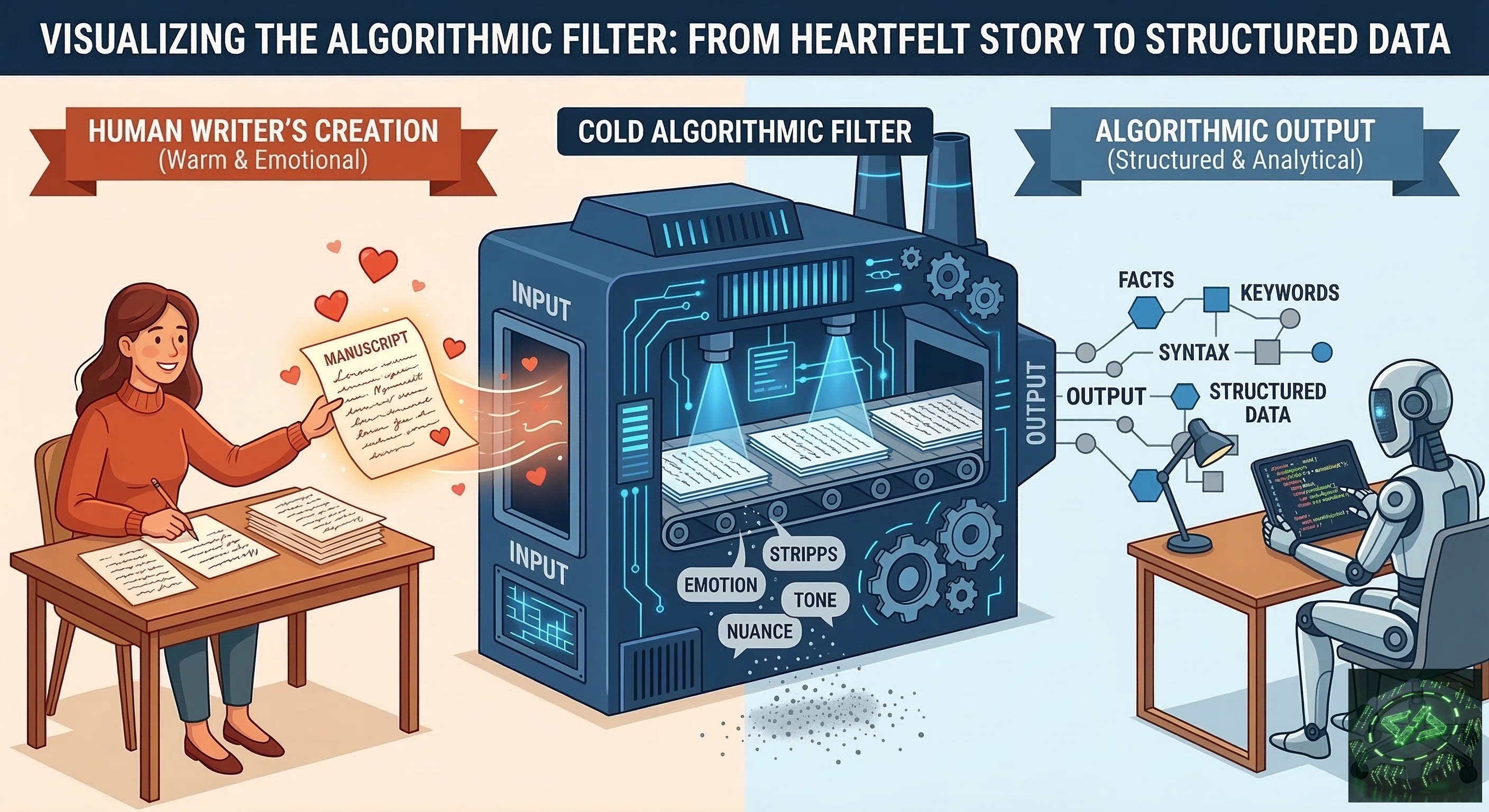
That is the reality of modern search. You are not writing for humans. You are writing to appease a hyper-complex algorithmic parser, begging it for the permission to be seen by a human.
When you write purely “for a human”—using colloquialisms, skipping obvious definitions because a human would already know them, or structuring a narrative non-linearly for emotional impact—the search algorithm punishes you. It deems your content “unhelpful” because it doesn’t neatly fit the robotic template of what it thinks a human wants.
The New Reader Isn’t Even Human
If the “write for humans” advice was slightly hypocritical in 2015, it is downright delusional today.
We have crossed the Rubicon into the era of Generative Search and Large Language Models. Your audience has fundamentally shifted. When you publish an article today, the entity most likely to “read” it is not a human on a lunch break. It is an AI web scraper.
Google’s AI Overviews, Perplexity, ChatGPT, and countless other LLM-driven tools are digesting the web in real-time. They crawl your site, strip away your unique voice, extract the raw data, and regurgitate it directly to the user in a zero-click interface.
If you spend your time writing lyrical, meandering, “human-first” prose, you are actually making it harder for the AI to parse your value. To survive in this ecosystem, you have to write like a machine, for a machine, so that a machine can easily cannibalize your work and feed it to a human who will never actually visit your website. You must become a pristine, highly structured data node.
The Myth of the “Helpful” Update
Google’s ironically named “Helpful Content” updates have routinely decimated independent publishers—the very people who actually write for humans—while rewarding massive corporate aggregator sites and AI-spun affiliate spam that perfectly mimics the structural signals of authority.
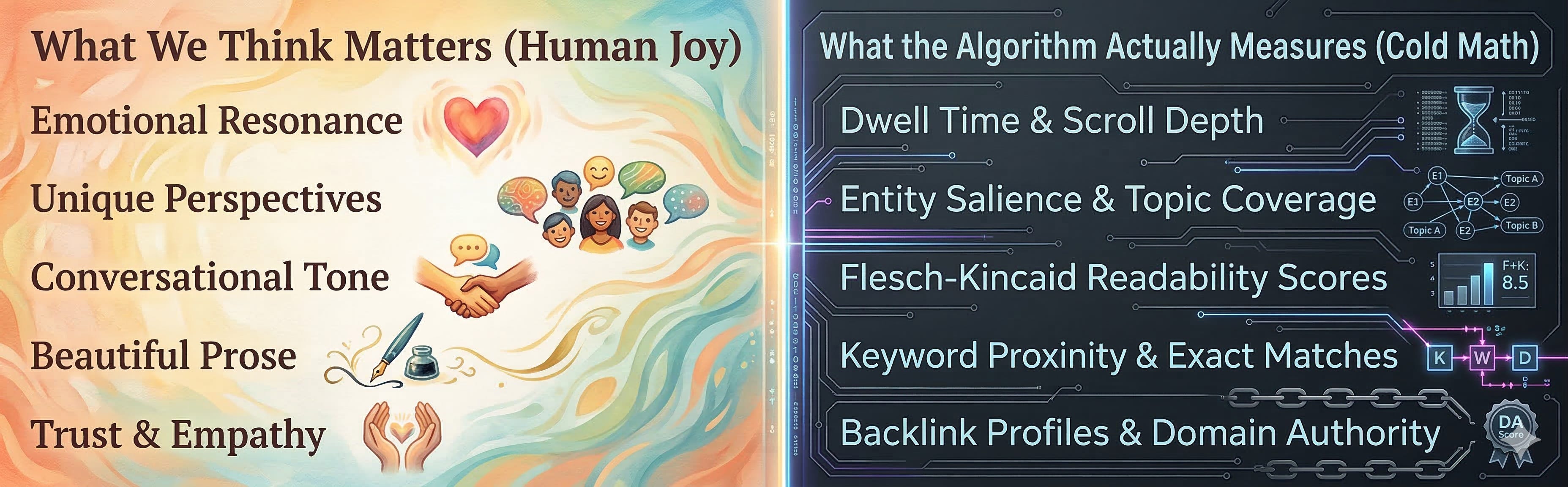
The algorithm cannot measure human joy, empathy, or true helpfulness. It measures dwell time, bounce rate, backlinks, and entity salience. It measures the metrics of human behavior, distilled into cold mathematics.
The Disconnect: Human Value vs. Algorithmic Metrics
When tech giants tell you to “write for humans,” what they are really saying is: “Generate the specific type of content that perfectly aligns with our current machine-learning parameters, so our AI can categorize it with minimum computational effort.”
The Only Way Out: The AI-Free Sanctuary
We are currently trapped in a dystopian loop: AI platforms telling human creators to act like humans, only to judge them by machine standards, and ultimately use their work to train more machines to replace them.
Until we see a mass migration to verified, mathematically “AI-Free” platforms—walled gardens where human identity is authenticated, algorithmic curation is banned, and chronological or human-curated feeds return—the advice to “write for humans” is worse than useless. It is actively harmful to your livelihood.
If you want to rank on Google in the 2020s, put your humanity in a box. Write the optimized, soulless, easily parsable drivel the algorithm craves. Give the robot exactly what it wants.
Save your true, human writing for the day we finally build a platform where the robots aren’t allowed inside.